It’s Sunday, the worst day of the week by far. I say that because they take this “day of rest” thing seriously in the Philippines, and it is the one day of the week when I always have trouble finding food and water and other things. Stores and restaurants are closed, and after the typhoon, it will be even worse.It was raining quite heavily in the early hours this morning, but it has tapered off and I think I see clear skies out there. I guess that means I will be doing some photography. Tomorrow morning, I hope to go out to the body identification site at Suhi. And perhaps that will be the end of my time in Tacloban. I’ll check on the navy ship today and also consider going on my bicycle to Cebu. My rides around Tacloban have given me some confidence in the bike if not in my knees. Time to hit the road, I think.I only sketched in the details of yesterday in my journal yesterday afternoon. I want to see if there is more to say. The main activity was going out to the mass grave at Basper. I had spoken to Gerald of the Fire Protection Bureau about going to the temporary morgue, and this is where he sent me. It turned out to be the wrong place, but it was an interesting excursion nonetheless.
Of course, all of Gerald’s directions were hopeless, wrong, and useless. He said that the turnoff to Basper was a big intersection and that there were signs there indicating the way and that the signs were marked “Basper”. None of that was true, and I rode right past the correct intersection without realizing it. I started to get the feeling that I had gone too far, and I stopped at one of those Police Assistance places to ask for directions. The Pulis there told me that I was heading in the right direction. I just had to continue on and “go straight.” I did that for quite a bit further, but I soon found myself almost at the San Juanico bridge, and there was no way that was right. The road was fairly close to the San Juanico strait here, and there was a lot of visible damage to buildings and trees and vehicles. There was even a fairly large ship washed up on the land.
I stopped a few more times to check my map and ask for directions, and then I turned around. I was surprised at how sour my mood had turned. Sure, the traffic was bad, but I hadn’t been out there long enough to justify how irritable I was feeling. And I think it was because this was one of the first times I was out on my bicycle on the road since the typhoon, and it reminded me of just how awful cycling in the Philippines can be and how I ended up staying in Tacloban for so long – the horror of being out there on the road again. It makes me doubt the whole cycling experience.
I stopped a few more times for directions and got nothing that was of any particular use. Filipinos seem to be terrible at giving directions. One last time I asked for directions, and I happened to be right at the intersection to Basper. The men I spoke with had no idea, but a young boy piped up and said that I just had to turn there and I would soon get to Basper. There were no signs, of course.
I got to see firsthand the destruction that the typhoon caused even away from the shore. It makes sense, I suppose, when I think about the power of that wind and the flimsy construction of the average Filipino village house. The wind I witnessed would have simply ripped the houses apart like they weren’t even there. The people had put their houses back together to get some immediate shelter and the houses looked like patchwork slum dwellings. I felt a wave of sadness and grimness wash over me as I rode down this valley. I felt so sad for these people that are stuck there and will likely live out their lives in those crude shacks and not get to experience much else. Not that any of the local people seemed to be suffering any of this sadness. Everybody I met was happy and called out the usual cheery greetings. I almost wish they would be grim and angry. It would make more sense and give me more hope for the country. Still, if I’ve learned anything it is that appearances can be deceiving in the Philippines. People live very scattered lives and these crude shacks are likely not the only dwellings they have. People here move around a lot and stay with relatives and have access to a wide variety of places to live. And while I was looking around reflecting on the grim nature of the poverty, I was passed by some very expensive-looking cars and some nice motorcycles. Still…
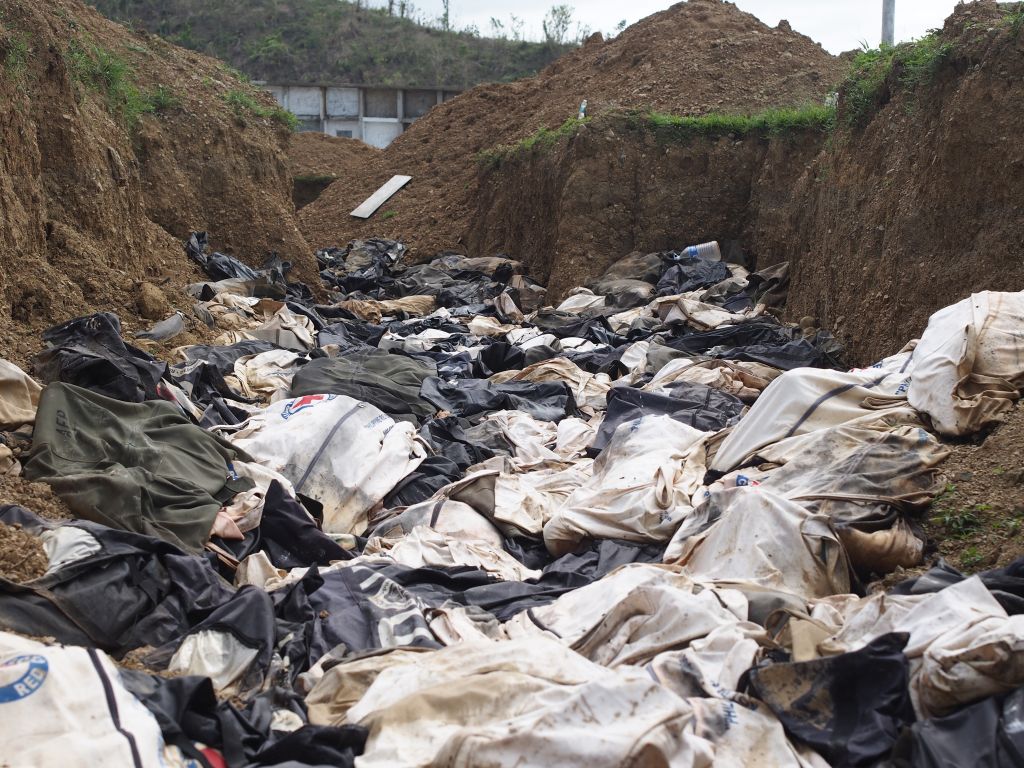
I was surprised to see that the mass grave I was looking for was right inside a cemetery. This was a full-on cemetery with big cement crypts. On the front of them would be photographs of the deceased and the usual messages, such as “In Loving Memory”. This made a sharp – very sharp – contrast with the giant pits filled with body bags right beside them. The pits were basically long trenches dug with a backhoe. I suppose if I had thought about it, I’d have hoped that the bodies had been laid down neatly in rows. I’d also have hoped that the bodies would then have been covered with something – with perhaps at least a layer of dirt. After all, there wasn’t a massive time pressure on anyone. Weeks had been allowed to go by for the body retrieval. Taking just a few minutes longer to lay down the bodies neatly and with respect would not have been a problem. But from the way the bodies were piled on top of each other and the way many of the bags had split open, it was pretty clear that they’d simply backed the dump truck up to the pit and then threw the bodies into the trenches. They probably did this the exact same way that I saw them being loaded onto the truck – men on each side of the bag and swinging it back and forth until they had enough momentum to heave it up to the bed of the truck where the other men could grab it. Then it was swung again and heaved onto the pile. This is almost certainly how the bodies were unloaded, and they would have been allowed to fall down into the trench.
I was really disappointed to see this. As I wrote yesterday, it was the kind of thing I’d have expected to see in a much less developed country and in a situation with much more urgency. I’m sure that if I bring this up in conversation, Filipinos will tell me that it was done this way because the bodies were decomposing so fast, and they had to get them buried quickly. And they will really believe this to be true. But, of course, if that were the case, then the bodies would have been covered with dirt. These bodies were heaved into the trench (who knows how many days ago) and then left there, exposed to the sun and rain and animals, to rot and liquefy. Looking at that massive and disgusting mess, I wondered what the point of the body bags even was. In this case, the body bags hadn’t even served to keep the bodies separate from each other. The bags had split open, and I saw skulls and leg bones and spines scattered about, all mixed together. The bodies themselves were turning to liquid and this was seeping out of all the bags and pooling together. They might as well have just thrown the bodies into the back of the dump truck by themselves and then tipped up the bed of the truck and dumped them en masse into a giant hole. The body bags and all that nonsense of taking pictures and using placards and putting the placard inside the bag would amount to less than nothing. There is no way that these bodies had been identified or would ever be identified.
I’m very curious about this whole identification business, but I know I won’t get any real answers from anyone. I brought it up (without much hope) when I was back at the fire station and chatting with Gerald again. I asked him if these bodies at Basper had been identified or were going to be identified. He just sidestepped the whole question and said that wasn’t their job. They just collect them. The BPI was in charge of identifying them. I really regret now that I didn’t go with the dump truck on the day I went out with the body retrieval team. The only way to know anything here is to see it with your own eyes. I would have liked to see them unload the 72 bodies that we collected that day and see what was involved. Asking people questions about what happened, will happen, or should happen is pointless. You never get any answers that make any sense.
A group of children was at a little stall across the road selling candles. They came over to watch as I got out my camera and took pictures of the bodies. They’d been living with the bodies for a while now and weren’t bothered by them in the slightest. They were joking and laughing and playing with a slingshot. The only reaction I saw was one that I’ve seen in everyone – they all started spitting. I don’t know if this is a Filipino thing or a standard human reaction to being around decomposing bodies. It makes sense when you think about it. You stop breathing through your nose, of course, and breathe through your mouth instead. And your mouth starts to water, and you really don’t want to swallow when you are around all those rotting bodies, so your instinct is to spit.
I’m not sure what the children thought of it, but I climbed down inside the trench to get a close-up picture of a skull and a spine. I was very careful not to slip and fall into the pool of goo and bodies. I accidentally breathed through my nose once, and my stomach began to heave immediately. I didn’t want to become a cliché – the greenhorn who throws up at the crime scene – so I quickly began to breathe through my mouth again.
Everything about that trench of bodies surprised me, and I wonder now what the international conventions are for dealing with a disaster like this. I remember seeing a big manual about dealing with large numbers of dead bodies at the Davao team’s site. I imagine an Internet search will produce lots of info about how dead bodies should be collected, identified and disposed of. I’m willing to bet that little of this proper procedure is being followed here. And considering how important the family is to Filipinos (at least they keep telling me this), it’s surprising. What family would not raise a fuss when they see all these bodies being treated in this way? I get this fatalist attitude from Filipinos. They seem to believe that things will always be bad and they simply don’t expect better things from their government and society. Maybe that’s why there is no outrage about this.
Or maybe the majority of the bodies have been identified. I just don’t know. But I doubt it. I haven’t seen anything being done that would lead in any way to an identification of the bodies. I keep hearing people talk about taking DNA samples. But that’s nonsense. A DNA sample will only help in identification if you have an original sample of DNA to compare it to. It’s not like there is a vast database of DNA profiles being kept on computer somewhere. And it’s also not like they are going to go around visiting homes and taking hair follicles off hair brushes to get DNA samples. There are no homes left to visit. And certainly no hair brushes. This is the Philippines, not CSI New York.