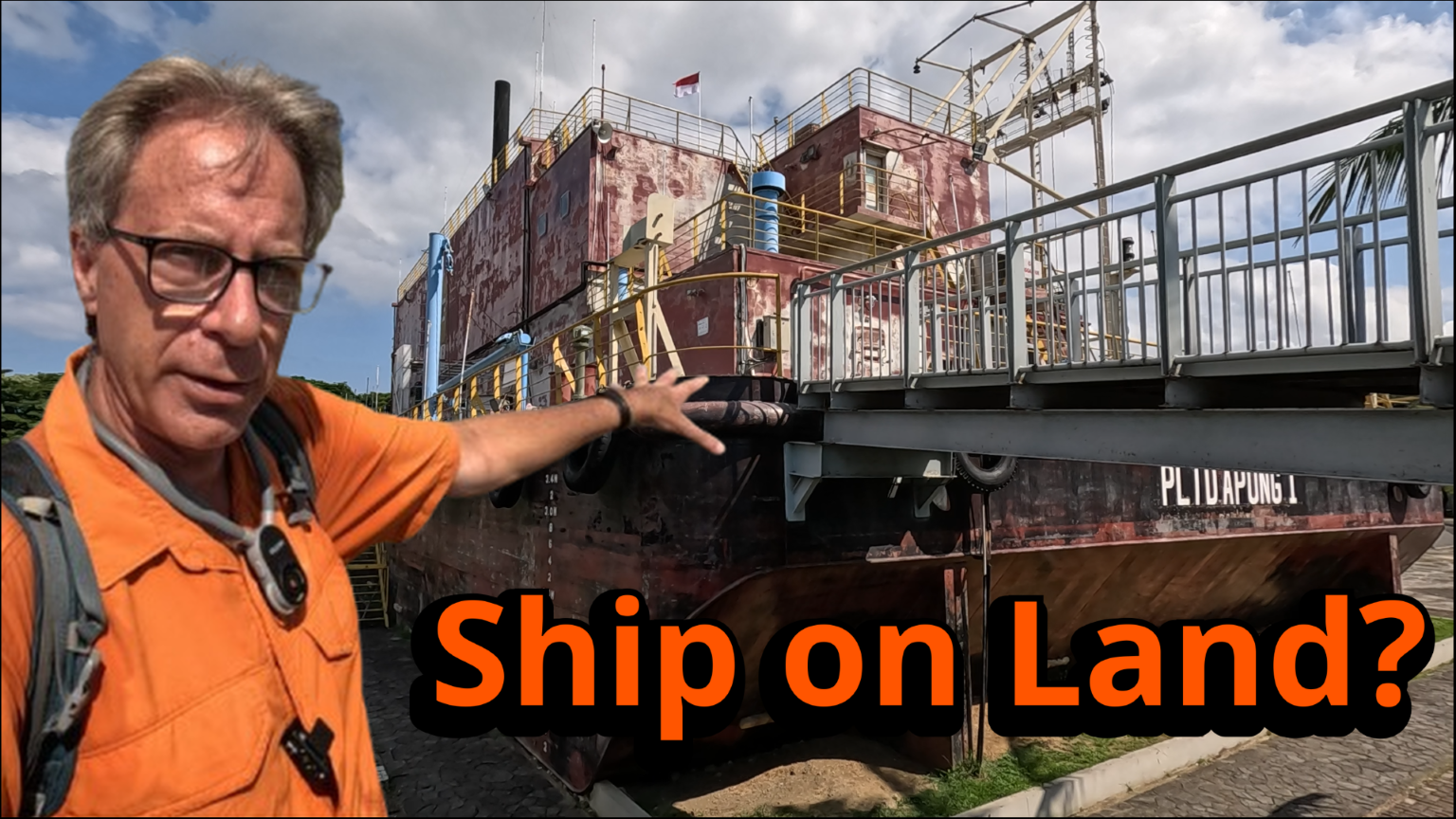
VIDEO DESCRIPTION:
I’d visited the fascinating PLTD Apung 1 Museum once already. Unfortunately, due to a variety of circumstances, I got there late, and I had only 30 minutes to do a quick walk-through. If the museum consisted only of the ship itself, perhaps that would have been enough. But to my surprise, I discovered that the interior of the ship had been converted into an actual museum with multiple exhibits.
So, on this day, I returned to PLTD Apung 1 making sure that I had enough time to do a deep dive into all the exhibits. I’m very glad I did so because this was my kind of museum: jammed with specific practical information about the 2004 tsunami and how this ship ended up on land kilometers away from the shoreline and the ocean.
VIDEO TRANSCRIPT:
But this is some information about that which is what we’re here to see. This massive ship again floated inland 5 kilometers from the ocean according to all the signs. Yeah.
Welcome back to another day on Planet Doug in Banda Aceh. The other day I tried to visit the Museum Tsunami Aceh but it was closed because of the ongoing power problems after the flooding and the heavy rains all across Southeast Asia. Apparently a lot of power like electrical generating towers like carrying power lines collapsed during the flooding. There were landslides, heavy rain and power was knocked out all over Sumatra and then in particular here in Aceh province. And when I tried to come here the other day, it was many days after the rain had stopped, but they still didn’t have power. And they said, “No, we’re closed because we have no electricity.” Now it’s a few days even after that and I’m here for a second try. I don’t see a lot of activity behind me. There’s nobody here. I don’t know whether it’s open or not. Let’s go find out. There’s the building. And assuming I’m going to be able to go in and look around. I can talk about the building a little bit. My understanding is that the architect Ridwan Kamil or something like that was his name. He designed it with three ideas in mind. One of course is to look like a wave. So you can see there is sort of a high wall and if you look at it from the top like an aerial view it has like a circular curving look to it like a tumbling wave. It was also designed along the lines of a traditional Aceh house a Rumah Aceh. And I don’t know if I can see it here or not to show you, but you see that the entire building is raised up on stilts exactly like a Rumah Aceh, which traditionally is lifted up on stilts partially to keep it out of flood waters. So that’s very appropriate for a tsunami museum to be up on stilts. The building also has elements of being a refuge. So, there’s supposed to be areas up on the top of the building to symbolize high ground so that people can escape to high ground to get away from a tsunami, a flood.
The last time I was here, even though it was closed, it didn’t matter that I just walked in because there are some displays on the outside. So, I just walked in. And it wasn’t until I was approaching the ticket office that some men came up to me and said, “No, it’s closed today because of the lack of power.” And we’ll see what happens. I don’t see a lot of visitors. And over here at the entrance, there are some shops that sell souvenirs. A souvenir shop they call them. Basically like tourism related items from Banda Aceh as well as commemorative articles about the tsunami. But none of those are open right now as well. Though it is early in the morning, 9:30.
So, couple of people walking around, which is a good sign. This man taking pictures. Looks like he’s here to visit the museum. So, yeah, you can see the scale of the building. It’s absolutely massive from the outside. Anyway, it looks huge and it does have a very intimidating feeling to it. I don’t know if that was deliberate or not on the part of the architect. When I was reading about this place, I heard the word brutalist tossed around that it comes from like a brutalist school of architecture, which I assume means a lot of gray cement, heavy slabs of cement. And even though a wave is very light and airy in a way, very full of foam and curving and motion, this looks like a static intimidating wall basically thundering down on you. And I think that was the intention of the architect to convey the sense of approaching power, approaching danger of the tsunami. And then they also wanted to have a little bit of an airy lightness to it which led to these openings like down here you can see all of the openings in the outer facade and the main wall has the same all the openings there. And again I think that is meant to represent water like the foaming moving bubbling water the wave the Museum Tsunami Aceh.
So we’re going to go around this corner right here and if the ticket window is open.
Closed. It says tutup closed. So again, I think they let me come inside. Like all the guards at the front, they just says, “Yeah, you know, go on in.” Even though it is actually not open. So yeah, last time I was here, I came up this way and there was a big exhibit of photographs. I went over them in depth talking about them. In particular comparing what I saw in the photographs with my experiences in Tacloban in the Philippines, which was also hit by a major flood, a storm surge during a typhoon. And I was comparing and contrasting my experiences in Tacloban with what happened here.
Attempt number two, failure. So, I don’t know how many more attempts I have in me because to be honest, based on everything I read, I don’t know that this style of museum was made with someone like me in mind. My sense is that it’s a very symbolic, a very emotional, a very hopeful kind of place. The funding for it and the idea to make it came at a time when there were so many NGOs in Banda Aceh still doing recovery work and there was a lot of ideas of preparing for future tsunamis commemorating the lives the hundreds of thousands of lives that were lost. So I think the museum followed that kind of pattern, you know, has that sort of an emotional tone. I’m more interested in the nitty-gritty details. That’s my personality. So I don’t know if the displays would have a lot of interest for me. I would be more interested in details about the tsunami itself, the numbers, figures, statistics, actual yeah, a deep dive into the wave itself, the earthquake that created it rather than how it feels. I want to know the scientific details about everything as well as the scale of the recovery. I was thinking about this quite a bit recently because when I was looking at the photographs on display at this museum, there was very little in the photographs that made sense to me based on my experiences in Tacloban. So, as I’ve said many times, I was in Tacloban when this super typhoon Yolanda hit the city and it created a massive amount of destruction just from the wind and the rain. I think it still holds the record as the most powerful typhoon in recorded history. The wind speed and the power of it. So, that destroyed a tremendous amount of the city. Heavy heavy rains and flooding. But then it also created a storm surge which is essentially a tsunami and it flooded it it hit the city with the force of a tsunami. So I was there when that happened. I saw it in real life. I was so cut off from everything that I didn’t really understand what was going on at the time. But I’ve had a lot of time since then to go back and fill in the gaps of my knowledge about what was going on. And then I stayed there for nearly 2 months during the reconstruction period where the city was rebuilding and that sort of thing, recovering from the disaster. Body recovery was a huge part of my time there. So there was a lot of food for thought particularly in terms of the actual mechanics of what a disaster like this entails. So when I look at the museum exhibits here about the Banda Aceh city, you know, the effects of the tsunami, I’m expecting to see what I saw in Tacloban, but times 100. The numbers are not that clear, but in terms of like how many people died in Tacloban, some people say it was about 7,000 people just in the city. Other people say it was like 15,000. But even if we go as high as the high estimates, 15,000, which I, to be honest, I think are closer to the truth, even 15,000 pales in comparison to how many people died here. I think there’s one mass grave about 15 km outside of the city that has 46,000 unidentified bodies in it. Like it’s one mass grave. I think in Aceh province I think 160,000 people died from the tsunami. So based on what I witnessed in Tacloban the effort of simply recovering dealing with that level of death that many dead bodies is just wow the scale of it must have been unbelievable. And it’s the same thing with dealing with debris because again my experience of Tacloban was that the city itself was paralyzed completely paralyzed for a long time because all of the debris debris 20 ft thick filled all the streets. So, the downtown core and we’re talking about the remains of thousands of houses made of wood, sheet metal, concrete, steel, rebar, all of that, and vehicles, cars, motorcycles, all of that piled together in this twisted mass of wreckage of wood and then steel twisted into spaghetti. And nothing could happen until that debris was moved and human power were incapable of dealing with that. So what I saw in Tacloban in terms of the recovery, nothing really started to happen until heavy machinery arrived like fleets of massive like bulldozers, frontend loaders, dump trucks. They had to get in there and finally clear away the debris so that the roads were now passable. And until that happened, nothing else could really take place. You couldn’t restore water, you couldn’t restore electricity, you couldn’t restore civic government, security, police forces. None of that could exist until the roads were cleared. And I saw the scale of machinery that was required to do that. But here in the photos at this museum, I saw two pictures talking about moving debris. And each picture was of an elephant, like two relatively small elephants. And again, it’s my understanding is the reality was that what happened here was on the same scale as Tacloban, but times 100. So here in Banda Aceh, the same thing happened here as in Tacloban. Massive fleets of heavy machinery had to come in and clear the streets and move debris. But I didn’t see any of that in any of the photographs, in any of the documentary, in any of the videos. You just don’t see any of that. So, I guess what I’m getting finally getting around to is that this museum, if it doesn’t contain that kind of technical detail, and it’s more about the feeling of hope and reconstruction and more of an emotional symbolic museum. It may not have a whole lot of information for me, so it’s not a big deal that it’s not open. I’m sure I’ll try again, but who knows? But on the bright side, there is another museum here, and I’m on my way to this other one. It is the diesel generating ship that was blown ashore, turned into a museum. I visited this museum as well the other day and I noticed that inside the ship there was a very interesting set of exhibits much more technical I think much more grounded in the real world but I got there so late I didn’t have enough time to look at it so that’s where I’m going since this museum is closed I’m going to walk back to this other one it’s called something like PLTD Apung or something like that the name of the ship and it’s this massive ship that actually was designed to generate power which I don’t understand why these ships exist but and it was blown 5 km inland like it was carried 5 km from the ocean into the shore by the tsunami and then deposited on the ground and then they just left it there like how are you going to pick it up and move it back to the ocean and they turned it into a museum. So, it’s a fascinating place and it might be a little bit more up my alley. So, I’m heading back there and then I’m going to do a deep dive into the exhibits at this museum. It was only a short walk from the main tsunami museum to this one which again I tried to remember the name. I think it’s PLTD Apung, like tsunami museum, which is essentially the name of the ship. And I have a little bit of video of this place already in my previous Planet Doug video. But, just approaching it now from the outside. Surrounded by this fence on all sides, and you’ve got to come all the way around to the front entrance. It took me a while to find the entrance. But I did. And it has this tower. You’re supposed to be able to climb up there and see the ship, but the stairs on that tower are built of wood and they’ve all rotted away. So the tower is closed. You can’t go up there. Hello. But it doesn’t really matter because once you can climb all the way to the top of the ship that you can see there and you get a really incredible view of the neighborhood just from the top of the ship. Of course from the tower you’d get a nice view of the ship but you don’t need it to see the neighborhood. There it is there. PLTD Apung 1 and it was essentially a diesel I think diesel generating station. Very unlikely that it was coal fired. I don’t really know much about it cuz as I said I didn’t have a lot of time to look at the main exhibit on the inside. I climbed around went up to the top but now I’m back for round number two. Can dive in a little bit deeper. Beautiful neighborhood here. Really nice. Gorgeous mosque up ahead as you can see. But so far so good. I found the entrance. Here it is. There’s the ticket window. 3,000 rupiah per person. There doesn’t appear to be a foreigner price here. It’s the same for everyone. And there’s the entrance. And you know you’re in the right place because the entrance is right across the road from this beautiful mosque. So if you head towards this mosque on Google Maps, that is where the entrance is and your ticket gives you a QR code which I need to scan to enter the grounds and go through the turnstile. Okay.
I noticed when I was here the other day, there was a tour group with an Indonesian speaking guide. And I think you can get your tours organized at that window over there. But no one has approached me, so I’m assuming that means there’s no English-speaking guides offering a tour. There’s a monument here sitting outside the ship. And interestingly, it has a clock. And the clock says December 26, 2004. That’s when the earthquake and tsunami took place. But it has as the time on the clock 5 minutes to 8 in the morning, which I don’t know what that means exactly because my understanding is that the earthquake struck at almost exactly 7:59. That’s when the earthquake took place and then the tsunami itself hit Banda Aceh 20 minutes later. So we got the earthquake basically at 1 minute to 8 and then the tsunami reached Banda Aceh at 20 minutes after 8. So 8:20 in the morning. That’s my understanding of the timing. But this is some information about that which is what we’re here to see. This massive ship again floated inland 5 kilometers from the ocean according to all the signs. Yeah, that’s what this sign here says. 2600 ton offshore diesel powered electric generator pushed 5 kilometers inland. And when I was here last time, I couldn’t help but contemplate what it must have been like for the local people because the same thing happened in Tacloban. Ships actually much larger than this one, which I again find kind of interesting that the scale of the two disasters have difficulty lining up in my mind because the Banda Aceh tsunami got so much international attention. The disaster in Tacloban was smaller in every respect. And yet in many ways, in my mind, it was quite a bit more dramatic and even larger because this ship was blown inland by the tsunami. But the ships that were blown inland in Tacloban were far larger than this. I don’t know, double, triple the size of this. Huge cargo ships were blown inland during the storm surge and the typhoon in Tacloban and they yeah they were a sight to see. They weren’t carried as far inland and again that’s partially because the land around Tacloban was more hilly and the ships didn’t float inland like they did here in Banda Aceh cuz the land here is so flat. It’s like an expanse of prairie almost. But yeah, they have this long metal walkway that goes all the way around the ship, which I walked on last time that I was here. I just had an interesting conversation with a young woman here who works as a tour guide for Indonesian tour groups. She actually spoke English, so she might be able to act as a guide for groups of English speakers as well. But we just chatted for a few minutes and one thing she told me is that this monument all the there’s names on the outside of the pillar outside of the triangle there. And there’s over a thousand names on that list and those are just the people that died in this village where she’s from this village where this ship came to rest and over a thousand people died just in this village and all their names are listed there.
But she told me something very interesting from her own personal story. She was 13 years old when the tsunami hit. So she has the story of her family. Her father died. Her mother survived and she and her sister survived. So she had some, you know, personal story to tell. And she said that so many people here died because they didn’t understand what was going on. They heard people shouting about water coming and they should run. That’s what everybody understood. So everybody ran. Even people that saw the water coming towards them rather than climbing up which may have saved many more people, they ran away from it. So they were all running away from the water because that was what they understood that that was normal for them. You’re at the beach, a wave comes in, you run away from the wave, you don’t get wet. Like nobody had experienced a tsunami before. So it never occurred to a lot of people to go up. They ran forward and of course the tsunami caught them. So there was all these people running down the streets thinking they could outrun the tsunami. And then of course they couldn’t and then they drowned because they didn’t climb up. In her case, she was not at home at the time and she and her sister hopped on a motorcycle. I assume her sister was older and was driving and they tried to outrun the tsunami on a scooter and even they couldn’t do that probably because the roads were crowded and the tsunami caught up with them and she survived because she climbed up a tree. She climbed up a mango tree and there were four other people up in the tree with her who all survived and then her sister climbed up another tree but a smaller one according to her. So yeah, fascinating story and again from my point of view this idea that all these people their instinct was to run away from the wave and now in the because of all of the education surrounding the 2004 tsunami, all these museums, word of mouth government programs, people might understand better and if a tsunami hits here, I think the instinct of most people will be to head for anything like there’s no high ground here. That’s also something very different from Tacloban. There were large areas right on the coast around Tacloban ringed by hills and people’s houses were on the thin strip of land in between the ocean and the steep hillside. And then when the typhoon hit and the storm surge hit and their houses were being wiped out, they ran and the hills were close enough they could run up the hill and get to high ground here. Well, let me No, I’ll do it from up on the ship. I’ll show you just how flat it is here. There is no high ground to run to. You could run to the tops of buildings, but most buildings here are not very high. You know these houses here and it’s one thing to say well just climb onto the roof but if you’re at ground level and let’s say you’re a little bit more elderly how are you getting up on that roof? I mean sure there’s rooftops but you’re not climbing up these pillars and getting onto this roof. Maybe you could climb up that fence over there but yeah you got to be young and spry and who knows whether these roofs can even support your weight that thin metal sheeting. Who knows? So, yeah, a lot of fascinating ideas about personal survival.
I shot video of this boat already, but I mean, it’s impressive enough now that I’m here. I have to do it again.
The size of this thing. Beautiful day, too, to shoot some video here. And the entrance to the museum is right here. This this door this open doorway. But I’m going to climb back up onto the top again. Yeah, I’ve got a lot more time this time. Got an hour and a half before they close for afternoon prayers. Yeah, I don’t know what this is all about. Was this part of the original ship or is it a set of lights that were tacked on when it became a museum? I have a feeling it’s part of the museum and it lights up the ship at night. Got
very steep stairs. Got to hold on to the railing here.
Yeah. And the woman telling me her story said that there was a woman in her mango tree with her who survived, but she was holding her baby in her arms the whole time that they were up in the tree. But the baby didn’t survive. I don’t know whether it drowned before then or exposure or what happened. But yeah, it’s a very tragic image to think of a mother managed to climb up into a tall tree with her baby to survive. And even then, the baby didn’t make it. But she still kept holding on. Of course she would. So yeah, here we are. And see what I was talking about. It’s just flat in all directions until you get to those mountains over there. And those are far away. Nobody’s escaping from the tsunami up in those hills. Nobody’s running that far. And over here. So in all directions, it’s just this whole area would have been inundated with the tsunami. The numbers that people tell me, it honestly doesn’t make a lot of sense, but I have no reason to doubt them. But this woman was saying that at the ocean, the water was 30 m deep. So 100 ft deep. And I don’t know, I just I find it difficult to wrap my head around that. And she said the water here was 5 m deep. But to be honest, I think that is a bit of a misunderstanding of how these things are measured. I noticed in some monuments scattered around the city, there would be markers that said at this point the water was 4 m deep. And I’m looking around and that would mean that all of the buildings there were totally submerged. But then when I did some research online about what these readings mean, well, they actually come from people measuring sort of a top level, like the highest point that water reached, but it doesn’t really mean that there was a lake 5 m deep covering this entire city. It’s like the wave was coming in and like maybe it even sloshed up to like the high water mark at that point was 4 m and out here it was 5 m. But it doesn’t necessarily mean that there was like if you looked out if you were up this high all you would see is a lake covering this whole area water like a 5 m deep lake. It wasn’t quite like that, I don’t think. But it’s there’s really no way to know the reality unless you were there seeing it. And again, this woman who acts as a guide here, she says her instinct was the same as everyone else was just to run away. And she and her sister had a motorcycle, a scooter. So, they hopped on their scooter and just tried to outrun the tsunami and they couldn’t do it and she eventually had to climb a tree in order to survive. Her mother made it onto the roof of their house and her father didn’t and I did ask her like what exactly like do you know why like why didn’t your father make it to the roof? Exactly how did he die? But she wasn’t really able to explain it in a way that made sense to me. But the impression I got was it was related to again this confusion and lack of understanding of what a tsunami was, which means maybe that her father also tried to outrun the wave, but he just wasn’t able to do it. So yeah, here we are on top of the ship. So let’s go inside and see what we can learn. I think this will be fascinating. This experience actually brings me back to my childhood because I grew up on the St. Clair River in Lake Huron, one of the great lakes of North America. And on the shore of the river, there were some ships pretty much exactly like this, tied to shore and been abandoned, like old rusty hulks. And as kids, of course, that was our playground. We’d ride our bicycles down to the river and make sure there’s no security guards around, no police. And then we would sneak through the fences and then climb onto these ships that were abandoned, basically just rusting hulks. And then it was our playground and we would dive off the edges cuz it was right on the river. And you could get for, you know, a kid a boat like this is pretty massive. And then we would get to the railing and then we could dive from the railing into the river below. That was our playground. So, I spent a lot of happy days in my childhood in the summer scrambling around on abandoned ships like this. And there’s a surprising amount of shipping in the Great Lakes and the St. Clair River. Huge ships going up and down that river. So, I grew up around a lot of boats like this. A lot of ships. So,
in we go.
Yeah, it’s air conditioned. The first exhibit here gives some really interesting information about this ship, which is what I was hoping to find out. And it turns out that the letters PLTD basically stands for like a floating electric producing barge. So that’s like an acronym for this type of boat. And this one is the Apung one. And what’s interesting about it is that they built these so that they could float around Indonesia and go from island to island wherever there was a risk of power disruption. So they could if an island lost power due to a storm or some other reason, this ship could arrive, dock off the shore, and then deliver power to the cities there, which is quite interesting. And it was docked here near Banda Aceh because the fighting between the Free Aceh Movement which you see here Gerakan Aceh Merdeka gam. So this was the Free Aceh like an independence force fighting against the Indonesian government. Because of the fighting here, there was a lot of power disruption where electrical lines were destroyed in the fighting and then this ship was brought here and parked offshore for when it was needed. And then when it was dragged inland, as they say here, 5 km inland, the electric company PLN, they wanted to drag it back to the ocean because the engines were still in good shape. There was nothing really wrong with the boat. So, they wanted to drag it back and keep using it, but the local people and the government said they wanted to keep it as a museum. So PLN removed the engines. I guess the most valuable part. They took out the engines, left the empty shell, and then that’s how they were able to turn it into a museum. Yeah, cuz I was wondering about that. I was like, where where are the engines? And it turns out the engines were removed. This is definitely my kind of museum. Very technical, very highly detailed, which I really appreciate. They just need a lot more light. I can’t read anything in here because it’s so dark. It’s really kind of exhausting trying to read in the dark. But one thing I was really curious about is where was this ship at the time of the tsunami? And this is where it was. It was actually docked and it was being held on shore by cables and ropes. And in fact at the time it was distributing power. So it was hooked into the Banda Aceh power grid and delivering power to all of these locations that you see here. And I was also curious about the crew like what happened to the crew? And according to this story there were 12 crew members. They were all on board at the time and they desperately tried to unhook the ropes and the cables mooring the boat, but they weren’t able, I guess. And then the ropes just tore free. And then some of the crew members jumped overboard, some of them stayed on. Five of the crew members died. Seven survived. And here is a very interesting story of when the ship was stranded here during the tsunami and how the local people reacted to it. So you have a whole bunch of survivor stories. So we have this man’s story, this man, this man, you know, this woman, they all, it’s a very detailed account of where they were when the tsunami hit, what happened to them. And they all came across this ship. And the ship was like a refuge for them because they were just looking for a place to get out of the water. And then a lot of people climbed aboard the ship and used it as shelter during the days after the tsunami, which is interesting. And there’s a story here about looting that people who were aboard the ship, they needed food, they needed water, things to survive, and they broke open the locks on the doors in the ship and a lot of things of value were looted from the ship in the days after the tsunami. So, I find that really fascinating.
I mentioned all of the survivor stories here in this display and it turns out that this story, this woman here, this is the woman that I was talking to outside, the one who was 13 years old at the time and she survived in a mango tree. So yeah, this is her, the woman that I was speaking to, and her story as she told it to me is laid out in detail here. Her search for her mother and her father. And yeah, her father’s body was never recovered, was never found. And this corner display talks mainly about the earthquake itself, which is quite fascinating. It’s all in Indonesian, of course, but I translated it into English, and it registered between 9.1 and 9.3 on the Richter scale, which makes it one of the most powerful earthquakes in recorded history. And it’s also the longest, like a lot of earthquakes just last seconds, but this one lasted at least 8 minutes, somewhere between 8.3 and 10 minutes long. And one thing I find really fascinating, something I learned actually, which I didn’t realize is that the wave didn’t come from the epicenter in a circle. Like when you think of an earthquake, they always talk about the epicenter and then they put rings around the epicenter and you think, well, that’s how the waves spread out. So if this is the epicenter, how did the wave hit Banda Aceh like from this direction. It didn’t make any sense. But what actually happened is there was a fault line 800 miles long about 1,300 km. So the two tectonic plates met here at this point and one of course was sliding underneath the other one over millions of years. The tension is building up. But then the tectonic plate that was being sucked down suddenly broke free and it just flipped upward almost like a diving board. But the part like the diving board that flipped upwards was 800 miles long. So in fact there was a line stretching all the way here like 1,300 km. The whole tectonic plate flipped upwards between 10 and 20 meters and then the tsunami wave spread out in a line in this direction and in this direction. So along this line the wave went in this direction and that direction and then I never really thought of it from that angle before. This smaller map might give a better idea that when you think about the earthquake, you don’t think about this tiny epicenter. You think about a line stretching all the way here. And from that line, the wave went in this direction hit Sri Lanka and then this direction hitting Sumatra, Thailand, you know, off in this direction. So it’s actually a line with a wave going in this direction and one in that direction. So completely different from how I was picturing it.
This video tells a fascinating story about exactly what happened to the boat. Fills in a lot of the details. Just talking about the crew on the boat, 12 members of the crew before the earthquake and the tsunami hit. They had just refueled the ship. So, it was completely refueled. Then came the earthquake
and then the water receded. And as the water receded, the ship tilted and was grounded. And according to this story, all 12 crew members abandoned ship at that point when the ship here, they all jumped off the boat and they all started running. So they weren’t even on the ship when the tsunami came in. And as I said, five of them died. And they talk about how eyewitnesses heard three explosions and each explosion basically was a crashing wave. So there were in fact three major tsunami waves that hit and then the boat was pushed by each wave one by one. So the first wave pushed it over here in this direction and it was sort of beached there and was just sort of resting at that point and then another wave or two waves, I’m not sure. You can see the direction that it had come
and they illustrate here how it was smashing into houses, destroying houses, which is quite interesting. Couldn’t imagine being somebody you might have been on a roof there trying to survive and you see this giant ship coming at your house.
But then another wave hits and the boat makes almost a right-hand turn and now it’s floating pure inwards. But look how far it goes. That’s the amazing thing. Look how far it travels. This really illustrates the scale of the tsunami and then it finally came to rest here. Punge Blangkut.
Yeah. Amazing story.
I’m up on the second or third floor now, whatever you want to call it. Gets a lot hotter up here. The air conditioning is pretty good down below, but it really starts to fade up here. But that’s the main exhibit area. There’s a tour group getting a tour right now. The main exhibit, and all the most interesting information is all down there at the bottom level. And then up here, there’s just a few more exhibits. This is all about the Rumah Aceh. Some cultural and historical information about Aceh province and then some more information here about the tsunami and the earthquake. There’s a little bit more I didn’t talk about down below where there’s an exhibit here on this far wall about sort of folk tales in the history of Sumatra and Aceh province stories you know handed down through generations of major tsunamis almost like legendary stories and children hear these stories and they learn what to do in the event of a tsunami almost through folktales.
And then there’s information up here about various like the numbers of earthquakes and tsunamis that have occurred all around Asia throughout history. So yeah, I’m just about getting to the end. One last look at the main exhibit area. Of course. Well, maybe three things to note about this museum if anybody’s going to come here. One is everything is in Indonesian. There’s zero English. So, make sure your smartphone is charged up and you have Google Translate ready to go. Otherwise, you really won’t understand anything. It can also be pretty hot in some parts of this and the stairs are very steep. And again, if you’re elderly and you have some mobility problems, I think you’re going to struggle with some of these stairs. But and the lighting. The lighting is very poor. It could be because of the power blackout. They could be running on just emergency lighting right now cuz I can see there’s lights inside here inside all these displays, but none of them are turned on right now. So, it’s very dark in here, very difficult to read, but that may be just because of the flooding and the current electricity shortage. As far as the exhibit goes on the inside, I guess that’s it. And it’s time to head outside. And there’s two other boats that I’m aware of that are nearby here. I don’t think they’ve been turned into full-on museums like this one has been, but these boats also were brought inland 5 kilometers by the tsunami, and I think they’re still there. So, I’m going to walk through the neighborhood and go take a look at these other two boats. I’m at the far corner of the museum complex now. They have toilets back here. Pretty rough around the edges, but they’re there. They work when you need them. And it looks like they occasionally or used to have Oh, it’s over here. A cafeteria, a cafe, a restaurant of some kind. Though from the looks of it, it hasn’t been open for a long time. Maybe during busy times of the year. You can get yourself a bowl of noodles. But from over here, yeah, you get an amazing view of the ship itself. I noted on the inside that there was a painting that had this rig here that looks like it has lights on it or something. And I thought, “Oh, that must be original then.” But then I saw a lot of photographs of the boat during the tsunami and that structure wasn’t there. So now I’m back to thinking that they added that rigging when the boat was turned into a museum. But yeah, I don’t know. It looks like it’s a power delivery system. I thought maybe it was for lights, but you can see some power lines coming off it. They’re all cut off down here. But yeah, who knows? Maybe it is an original structure. Maybe it broke during the tsunami and then they repaired and replaced it. Not sure. But anyway, there it is. The floating diesel barge Apung 1. And now on the hunt for another ship. Oh, and they actually have a sign just spotted it. Kapal KPLP. So KPLP must be an acronym for another type of ship. 100 m this way. And I don’t know anything at all about it. I don’t know the history other than it was brought here by the tsunami exactly in the same way as the PLTD Apung 1 was. So I guess you when you get to this point you just start looking around. You see houses and somewhere around these houses there’s something that doesn’t belong. Ah, yeah. It jumps out at you right away. Boat. Look at that. A boat right in the middle of all these houses.
So, let’s see if there’s any information about it or any sort of a museum quality. But yeah, can you imagine though? I mean, floating all the way here and then getting deposited is difficult to comprehend. Yeah, this is not a tiny This is not a rowboat either, is it? This is a full-sized or mid-sized ship right in the middle of a residential neighborhood. That is crazy.
So, from this side, get another view of this boat right in the middle of all of these village houses. And there’s a second
second ship here, smaller one.
I don’t see any kind of a ticket counter or box where you can
deposit some money. So yeah, hasn’t been developed into a tourist attraction other than being left here. And this is the Kapal Malahayati. Oh, that’s cool. That’s the name of my hotel in Tanjung Balai. So, I have very fond feelings for that name, Malahayati.
They even built some stairs so you can climb onto it. Look at that.
Ah, it’s just wild.
Oh, and they even have a toilet. So, they really did develop it to an extent as a tourist attraction. Got bathrooms.
And I wonder what condition this boat was in at the time of the tsunami. It’s obviously been stripped. If there was anything in here, it’s all gone now.
Yeah. But it’s clearly not been safeguarded.
Look at that. It’s like a death trap down there. If anybody trips and falls in there or ends up down there, you do not want to go down there. So, it’s not been fully refurbished. Who knows about the safety of the floor? The whole thing is rusting through.
There through the window you can see the other boat.
And that’s about it for this morning’s video. Winding down, heading back to my hotel. I stopped at a little place behind me there for lunch and had a bubur ayam which was very very good. Yeah, the internet is down everywhere like mobile internet which is a bit inconvenient. I keep wanting to pay using Malaysia’s Touch ‘n Go e-wallet scanning QR codes here. A lot of these restaurants they have the QR code on display. I managed to pay a grab car driver using that method, but then the mobile internet disappeared right after that. So, everywhere I go, it’s one thing you need in order to use an e-wallet. You need the internet and it keeps I’m assuming it’s related to the ongoing electricity shortage here in Aceh Province. A lot of places Yeah. Just still don’t have electricity. So, I don’t really know what’s going on with that. And as far as the tsunami museum is concerned, I’m getting all kinds of conflicting reports. That’s normal. And when you’re a foreigner overseas, you have to get accustomed to just swimming in an ocean of misinformation. You’ll never know what’s going on and you just have to accept it. People will tell me, “Well, they’re closed because there’s no electricity. Come back tomorrow. The electricity will return or come back in 3 days, somebody else will tell me. So, I came back in like 4 days or so and then someone tells me, “Oh, no, no, they’re still closed because there’s no electricity.” And then I speak to somebody else and they say, “Oh, no, no. They’re fixing something right now and they’ll be open in 2 hours. So, if you wait for 2 hours, they’ll be open.” So, that’s what another person tells me. The third person told me, “No, no, they’re renovating.” So, there was a power failure, but they’re also renovating and after the renovations, they will reopen, but nobody knows what the truth is. Nobody knows how long the renovations will I mean, nobody knows anything. So, as a foreigner, you know, even less than they do, so you just give up. But luckily for me, the ship, the PLTD or PLTD Apung 1 was open. Fascinating place that I enjoyed very very much. You get a lot of details, a lot of specific information about that ship, its role, what it does, what happened with the tsunami. You even get that amazing digital map showing you the path it took to get to where it is now. Really nice. Enjoyed that museum very, very much. And it’s a nice little epilogue to that experience to go see the other two ships that were brought there by the tsunami. So, now that I had a good lunch, heading back to my hotel to relax a little bit. So, I hope you enjoyed that as much as I did. And as always, I’ll see you in the next video.